Is COVID-19 a Good Reason to Destroy America?

By Jack Pelham

I won’t venture to make any predictions about the medical side of things, because I’m not even remotely educated in epidemiology.  But when it comes to the political and financial “remedies” that have been enacted in the name of saving us from COVID-19, I think that some Reality-Based Thinking is in order.  It seems to me that a soft coup is in play, using the crisis as cover for quickly and permanently transforming America into something she would never legally vote herself into being. 

Now, you should know that I don’t belong to any political party.  Rather, I’m with George Washington when it comes to “the baneful effects of the spirit of party.”1  No, I’m talking about something much worse than that; I’m talking about the sinister undermining of our fundamental principles by people who lust after money and power that is not rightfully theirs.

I don’t have room in this present article to give you a detailed list of the lying, cheating, and stealing that’s been going on, but I’ve detailed it in a separate article here.  It discusses many sinister developments, including, of course, the unfolding unconstitutional bailouts that’ll likely end up to be nine times bigger than the one that got so many people picketing on the statehouse and courthouse lawns all across the US in 2008/2009.  So, if you’re not already familiar with these issues, please take a few minutes to read about them.

If COVID-19 really necessitates all this, then where’s the rush to amend the federal and state constitutions to allow for this kind of governmental power?  I think it shows our society’s prevailing unruly and undisciplined attitude toward the Rule of Law and our preference for the more-carefree Rule of Man.

Millions will argue, of course, that the “general welfare” language in the Constitution solidly authorizes these COVID-19 efforts, along with anything else we might deem to be good and useful.  But how does, say, funding a bridge in Pittsburgh serve the general welfare of the Union?  That’s specific welfare, not general welfare!  The very notion that the term “general welfare” entitles Congress to do anything it likes would mean the framers were wasting their time to enumerate all of Congress’s powers in Article I, Section 8!  But the liars never seem to tire of the game—excusing most every transgression by this frayed and irrational argument.

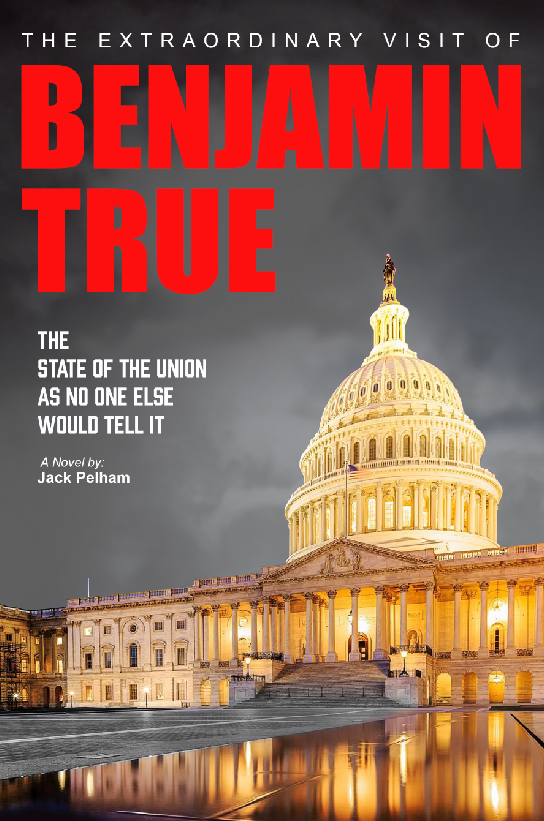
In my novel, The Extraordinary Visit of Benjamin True:  The State of the Union as no one else would tell it, the protagonist locks horns with a moral-relativist senator who talks big about dealing squarely in general, but who frequently cheats in order to get his way.  He stings the senator with this rebuke: 

“One big difference between you and me, Senator, is that I think that wrongdoing is wrong even when you do it.” 

~Benjamin True

Watch closely for yourself and see whether those who cry “Foul!” in government don’t frequently commit the same transgressions themselves.  We call this hypocrisy, of course.  It is run-of-the-mill cognitive and moral corruption.  Yet we allow it to be common practice in our governments—and that’s our fault.  And we’re about to pay the price for it in a bigger way than ever before.

Many politicians, of course, would think I’m being ridiculous, and that in light of the danger of COVID-19, the notion of following arcane constitutional rules is just stupid.  For them, I have some questions:

  1. If you think that following the Constitution is sometimes stupid, why did you take the oath to protect and defend it?  Does your word count for nothing?  Did you lie under oath just to keep the job?
  2. If you can violate the Constitution anytime you think you have a “good cause”, then is there really any limit whatsoever to the powers of the government?
  3. If the Constitution is such a hindrance to good government, why don’t you amend it legally, rather than trying to cheat your way around it?

Sadly, few American citizens understand the Constitution well enough to be alarmed.  And that’s worse than it was in the beginning, when more of us cared about it.  What’s also worse is that so few Americans today know what their legal rights are, or how the political process operates.  But this was not always so.  In the 1830s, about one generation into the life of our Constitution, a French writer visited to survey American life.  He complained that the Americans’ knowledge of European affairs was fuzzy, …

“…But interrogate him about his country, and you will see the cloud that enveloped his mind suddenly dissipate; his language will become clear, plain and precise, like his thought. He will teach you what his rights are and what means he must use to exercise them; he will know by what practices the political world operates. 2  (Emphasis added)

Alexis de Tocqueville, Democracy in America

Why did we ever let this knowledge go?  Did you know that it only takes about 45 minutes to read the US Constitution?  You could read it once a year and get a great return on the investment of those few minutes.

There were times in the beginning when we needed those “Minutemen” to be ready with their guns in order to fight off the tyranny of the British Crown.  And if we needed men and women with guns today, we could probably get them.  But the need of the moment is a few million exceptional patriots who are well-versed in the Constitution and who will raise a fuss sufficient to put the government back on its leash.  

As my character, Benjamin True, says to the people: 

“Life is short; why not be something extraordinary while we are here?”

~Benjamin True
  1. George Washington.  Farewell Address.  17 September 1796.
  2. Alexis de Tocqueville, Democracy in America. English Edition. Edited by Eduardo Nolla. Translated from the French by James T. Schleifer. (Indianapolis: Liberty Fund, 2012). Vol. 1. 3/30/2020. <https://oll.libertyfund.org/titles/2735>
Posted in COVID-19, Economy, History, My Books, Politics, Rule of Law | Tagged | Leave a comment

Limitations on Federal Laws

With the new surge of federal overreach related to COVID-19, I thought it would be good to put a couple of things on the record here for my readers’ convenience. This is a very simple post, showing two excerpts from the US Constitution. And at the end is a brief explanation of the most common cheat in constitutional law.

THE POWER TO MAKE LAWS

First of all, we should note that the Constitution does not allow the Supreme Court or the President to make laws. No, that power is given only to the Congress. Among other things, this means that Executive Orders and directives of the President are illegal, except where he is ordering the business of his own federal departments (over which he has rightful executive authority).

ARTICLE 1
Section 1
All legislative Powers herein granted shall be vested in a Congress of the United States, which shall consist of a Senate and House of Representatives.

In short, this means that there are no legislative (law-making) powers granted by this Constitution to any person or institution but the Congress.

THE KINDS OF LAWS THE CONGRESS MAY MAKE

Some think that the Constitution gives Congress practically-unlimited powers to do whatever they please, but this is not true. Congress’ powers are limited, and they are listed in Article I, Section 8 of the Constitution. Study this list thoroughly and ask yourself whether they have the power to give away “stimulus” or “bailout” checks, or to suspend the freedom of assembly, or of travel–or to authorize anyone else (such as the President) to do such things in their stead.

Article 1 – The Legislative Branch
Section 8 – Powers of Congress

The Congress shall have Power To lay and collect Taxes, Duties, Imposts and Excises, to pay the Debts and provide for the common Defence and general Welfare of the United States; but all Duties, Imposts and Excises shall be uniform throughout the United States;

To borrow money on the credit of the United States;

To regulate Commerce with foreign Nations, and among the several States, and with the Indian Tribes;

To establish an uniform Rule of Naturalization, and uniform Laws on the subject of Bankruptcies throughout the United States;

To coin Money, regulate the Value thereof, and of foreign Coin, and fix the Standard of Weights and Measures;

To provide for the Punishment of counterfeiting the Securities and current Coin of the United States;

To establish Post Offices and Post Roads;

To promote the Progress of Science and useful Arts, by securing for limited Times to Authors and Inventors the exclusive Right to their respective Writings and Discoveries;

To constitute Tribunals inferior to the supreme Court;

To define and punish Piracies and Felonies committed on the high Seas, and Offenses against the Law of Nations;

To declare War, grant Letters of Marque and Reprisal, and make Rules concerning Captures on Land and Water;

To raise and support Armies, but no Appropriation of Money to that Use shall be for a longer Term than two Years;

To provide and maintain a Navy;

To make Rules for the Government and Regulation of the land and naval Forces;

To provide for calling forth the Militia to execute the Laws of the Union, suppress Insurrections and repel Invasions;

To provide for organizing, arming, and disciplining, the Militia, and for governing such Part of them as may be employed in the Service of the United States, reserving to the States respectively, the Appointment of the Officers, and the Authority of training the Militia according to the discipline prescribed by Congress;

To exercise exclusive Legislation in all Cases whatsoever, over such District (not exceeding ten Miles square) as may, by Cession of particular States, and the acceptance of Congress, become the Seat of the Government of the United States, and to exercise like Authority over all Places purchased by the Consent of the Legislature of the State in which the Same shall be, for the Erection of Forts, Magazines, Arsenals, dock-Yards, and other needful Buildings; And

To make all Laws which shall be necessary and proper for carrying into Execution the foregoing Powers, and all other Powers vested by this Constitution in the Government of the United States, or in any Department or Officer thereof.

Many will try to cheat by way of that that first enumerated power (emphasis added):

The Congress shall have Power To lay and collect Taxes, Duties, Imposts and Excises, to pay the Debts and provide for the common Defence and general Welfare of the United States; but all Duties, Imposts and Excises shall be uniform throughout the United States;

Article I, Section 8, Paragraph 1

They will argue that anything, then, that is good for the “general welfare” of the United States is allowable. This cannot, however, have been the intent of the Framers in using this phrase. If it had been, none of the other items in this list of powers would have been necessary to write. It simply does not, and cannot, mean that Congress is authorized to pass any law they like.

Further, if you watch the kinds of acts of Congress for which this “general welfare” reasoning is used as “justification”, you’ll see that in most cases, they do not promote the “general” welfare of the Union, but the specific welfare of certain factions or localities. Putting in a bridge in Alabama, for example, does nothing to help the welfare of Wyoming. Or providing support to New York City does nothing to help the people of Red Boiling Springs, Tennessee. Even so, this “general welfare” notion is frequently employed to justify unconstitutional acts of Congress.

Posted in Politics | Leave a comment

Have We Become Too Corrupt, Mister Franklin?

Benjamin Franklin was older than the others involved in the Constitutional Convention in 1987. These delegates from the various colonies represented many factions–many different ways of thinking. They had their biases, of course, and their cheats–along with whichever of their convictions were true and righteous. But they also had varying degrees of foresight as to what was likely to happen.  That is, they had different levels of understanding, both as to how the Union should be conducted, and as to how the various decisions they would make would play out in the real world.  They had different levels of skill at decoupling from the deliberacy of their wishes in order to analyze what was likely to be the results.

When the drafting of the Constitution had gotten close enough (in his opinion) to being serviceable, Franklin wrote a speech to be read to the assembly, being too infirm to present it himself. I have copied the speech below in its entirety, and I hope you’ll take a couple of minutes to read it, as it is not very long. Of particular interest, however, is the sentence that I have highlighted in boldface in the speech below, and that I have excerpted in its immediate context here (emphasis added):

In these Sentiments, Sir, I agree to this Constitution, with all its Faults, if they are such; because I think a General Government necessary for us, and there is no Form of Government but what may be a Blessing to the People if well administered; and I believe farther that this is likely to be well administered for a Course of Years, and can only end in Despotism as other Forms have done before it, when the People shall become so corrupted as to need Despotic Government, being incapable of any other.

From Benjamin Franklin’s final speech to the Constitutional Convention. 1787.

The framers of our Constitution who met that summer in that hot Philadelphia room definitely wanted to avoid despotic government, and with good reason. They had recently fought a war (1785-1783), revolting against the occupying armies and the remote rule of the despotic King George III. Further, they definitely thought themselves capable of ruling themselves. Self-determination–the business of deciding for ourselves how best to govern–was the driving idea behind the revolution. And even so, not all of the colonials agreed it was proper to put off the king’s rule. They were very divided.

But as the king’s tyranny had increased, the colonies had become more and more likely to see self-rule as the best solution. So, they had ventured the war and won it. And now, some four years later, as their original constitution (The Articles of Confederation) had proved insufficient to hold the states together, they had come back to the table to hammer out this new Constitution, aimed at forging “a more perfect Union”—and they still wanted to avoid despotic government.

Franklin, however, warned of a time when such a totalitarian government might be the only way to hold the people together. He had said that any of a number of governmental types might well work—if “well administered”, mind you, and that this newly-proposed Constitution was just as likely to work. But there was a second limit to how well it could work. Not only did it have to be “well administered”, but it would not work on a people that had become too corrupted. No, he suggested that people who are too corrupted, simply require a totalitarian dictator to keep a society functioning.

John Adams, speaking of the same Constitution, would later remark in a letter that:

“Our Constitution was made only for a moral and religious People. It is wholly inadequate to the government of any other.”

John Adams to Massachusetts Militia, 11 October 1798

I think that both Adams and Franklin were seeing the same things: that the citizens were going to have to supply their own character, and that the righteous maintenance of the new government would rely on them doing it.

But what has become of us? Have we proven since 1787 to be a people who are sufficiently moral to keep our own government on the straight-and-narrow?

Uh, no. We have not.

The same motley crew of citizens, some of whom had cheated to get their way in events like “The Boston Massacre” and “The Boston Tea Party” would continue to cheat against the very Constitution they had just toiled to commit to paper, and to which they had to swear allegiance if they were to hold office under it. For example, the very first Congress passed the Judicial Act of 1789, which undermined the authority of the sovereign states in the Union by unconstitutionally granting the US Supreme Court (and its inferior federal courts) the power to hear appeals of state court decisions.

And did the people rise up to put an end to that lawless overreach of the Congress?

Nope. There was opposition, but it was not sufficient to repeal the lawless Acts, nor to punish those who had dared to enact them. The states had signed off on the Constitution, but then they proved not to be up to the task of being good citizen-overseers of the form of government they had chosen. The reality of the Americans actions simply did not live up to the grandiose rhetoric they had adopted. And they had ample opportunity to oppose the cheating.

Let me give you a compelling example:

This same John Adams (the 2nd president under the new Constitution), who called for “a moral and religious people” to uphold the Constitution, also signed into law the terribly-unconstitutional Alien and Sedition Acts of 1798. If you don’t know about these acts already, you might not believe their audacity, but among other things, they made it illegal for anyone to criticize the government, up until the time of the end of Adam’s term as president! (In case it hasn’t occurred to you yet, this blatantly violates the First Amendment and that foundation of all freedoms, the Freedom of Speech.)

Now, there was opposition to the Alien & Sedition Acts. There was definitely an outcry. But was it sufficient to have the acts repealed and the enactors punished? No. And that’s the only outcome that would really count for anything. The citizens-overseers failed to get the job done. And the lawlessness continued on with the citizens quickly getting use to “the new normal,” as we would call it today.

Is that what Mr. Franklin meant by “so corrupted”? I think it is.

I think it’s very easy to have a view of ourselves that doesn’t match with the reality of ourselves. For example—and I don’t particular mean to pick on Texas, but they have provided this excellent example: “Don’t mess with Texas!” is a popular warning/boast, but even so, Texas has been “messed with” by way of federal overreach for a very long time. The state’s original self-determination has been undermined in countless ways by the ever-encroaching Federal Government, yet the people of Texas (who repeat this saying) seem to have a higher view of their self-determination than is warranted by the facts.

My apologies if it seems like I’m singling out Texas, because I’m not. I think that all Americans are vulnerable to this sort of self-inflated view of ourselves as protectors of the Constitution, or of our rights. We have been defeated so many times that such boasts are laughable, yet I don’t think we understand the track record that makes them so. We don’t understand what all has happened, and what it means. And this comes as little surprise when each generation ends up knowing less about the Constitution and our history than did the one before it. Further, with the advance of communications technologies, each successive generation has had more and more access to information, and yet uses that access less and less to focus on these important civic topics, and more and more for their own entertainment.

Is this the kind of corruption that Mr. Franklin had in mind?

In 2008/2009 I found myself with a picket sign in my hand for the first time in my life, protesting the T.A.R.P. bailouts on the Capitol lawn in Tallahassee, FL. These current bailouts could be 9-or-more times bigger before it’s all said and done, yet I think that the people have quickly gotten used to this “new normal”, and will hardly lift a finger in protest. It’s a sudden burst of speed in our longstanding descent down the slippery slope of lawlessness. And now the people are finally getting direct payments from the government into their bank accounts. It’s gone that far.

Were we heroes in the 2008/2009 protests? We might like to think so, but the fact of the matter is that our efforts fell far short. We failed to get the job done. We stood up to the government by protesting, but when the IRS cheated by failing to approve the tax-exemption applications of all those new “Tea Party” groups, most everybody quit pushing back. And the lesson we demonstrated was this: Americans have a definite limit to how far they are willing to go to put their government back on its rightful leash.

In 1789, America started a thing it could not finish. It bit off more than it could chew. It created this government, but proved unwilling to give it spankings as needed. It failed to live up to the piece of wisdom that Ben Franklin had metaphorically raised with this proverb:

“…it is easier to build two chimneys than to keep one in fuel. “

Benjamin Franklin (1848). “The Way to Wealth”, p.7

In case you don’t “get it” right away, here’s the point of this metaphor: It’s easier to build a government than it is to keep it running right. And we have definitely failed to keep it running right. The government, which was supposed to be the servant of justice, became self-aware and self-serving. And how we are so far gone down that slippery slope that the only quick reform possible–even if unlikely–is that some benevolent and righteous king somewhere should take over our country and set things straight for us without our (corrupt) say-so in the matter.

But where will we find such a king? Surely not in Russia, nor in China. Nor in the United Nations. No, the emergence of such a king is itself as unlikely as is the idea that a few million Americans might suddenly take a notion to go learn the Constitution and what it means over these next few weeks, and from there, become effective citizen-overseers of their own local, state, and federal governments.

We have become so politically corrupted as to be incapable of self-determination in our current attitude and knowledge alike. The idea of taking the bull by the horns and getting something done is more foreign to us than ever. And that makes us incapable of ruling ourselves anymore—and much less of ruling our own government, whose members simply want control of the Union more than we do. (I expound on this in my Gold Bar Metaphor chapter in my novel.)

I think you were right, Mr. Franklin, to think ahead as you did—to see the possibilities of what might go wrong and how it might all play out. We have proved your analysis by our own negligence. And in this latest hurry-up to corrupt our government even further, we show no meaningful signs of turning ourselves around. I doubt very much that we could find even one in a hundred among us who understand what time it is, and of those, probably not one in a hundred would be willing to do the work required to reform the country. We have definitely become incapable.

Mr. President:
I confess that I do not entirely approve of this Constitution at present, but Sir, I am not sure I shall never approve it: For having lived long, I have experienced many Instances of being oblig’d, by better Information or fuller Consideration, to change Opinions even on important Subjects, which I once thought right, but found to be otherwise. It is therefore that the older I grow the more apt I am to doubt my own Judgment, and to pay more Respect to the Judgment of others. Most Men indeed as well as most Sects in Religion, think themselves in Possession of all Truth, and that wherever others differ from them it is so far Error. Steele, a Protestant in a Dedication tells the Pope, that the only Difference between our two Churches in their Opinions of the Certainty of their Doctrine, is, the Romish Church is infallible, and the Church of England is never in the Wrong. But tho’ many private Persons think almost as highly of their own Infallibility, as of that of their Sect, few express it so naturally as a certain French Lady, who in a little Dispute with her Sister, said, I don’t know how it happens, Sister, but I meet with no body but myself that’s always in the right. Il n’y a que moi qui a toujours raison.

In these Sentiments, Sir, I agree to this Constitution, with all its Faults, if they are such; because I think a General Government necessary for us, and there is no Form of Government but what may be a Blessing to the People if well administered; and I believe farther that this is likely to be well administered for a Course of Years, and can only end in Despotism as other Forms have done before it, when the People shall become so corrupted as to need Despotic Government, being incapable of any other.

I doubt too whether any other Convention we can obtain, may be able to make a better Constitution: For when you assemble a Number of Men to have the Advantage of their joint Wisdom, you inevitably assemble with those Men all their Prejudices, their Passions, their Errors of Opinion, their local Interests, and their selfish Views. From such an Assembly can a perfect Production be expected? It therefore astonishes me, Sir, to find this System approaching so near to Perfection as it does; and I think it will astonish our Enemies, who are waiting with Confidence to hear that our Councils are confounded, like those of the Builders of Babel, and that our States are on the Point of Separation, only to meet hereafter for the Purpose of cutting one another’s throats. Thus I consent, Sir, to this Constitution because I expect no better, and because I am not sure that it is not the best.

The Opinions I have had of its Errors, I sacrifice to the Public Good. I have never whispered a Syllable of them abroad. Within these Walls they were born, and here they shall die. If every one of us in returning to our Constituents were to report the Objections he has had to it, and use his Influence to gain Partisan in support of them, we might prevent its being generally received, and thereby lose all the salutary Effects and great Advantages resulting naturally in our favour among foreign Nations, as well as among ourselves, from our real or apparent Unanimity. Much of the Strength and Efficiency of any Government, in procuring and securing Happiness to the People depends on Opinion, on the general Opinion of the Goodness of that Government as well as of the Wisdom and Integrity of its Governors. I hope therefore that for our own Sakes, as a Part of the People, and for the sake of our Posterity, we shall act heartily and unanimously in recommending this Constitution, wherever our Influence may extend, and turn our future Thoughts and Endeavours to the Means of having it well administered.

On the whole, Sir, I cannot help expressing a Wish, that every Member of the Convention, who may still have Objections to it, would with me on this Occasion doubt a little of his own Infallibility, and to make manifest our Unanimity, put his Name to this instrument.

Posted in Character, Economy, Politics, Rule of Law | Leave a comment

To a Hammer, COVID-19’s a Nail

Perhaps you’ve heard the old saying, “To a hammer, everything’s a nail.” It describes the cognitive bias we can have in how we see the world. It’s a self-centered way of viewing things. Being a typical claw hammer, nail driving and pulling would be all I would do. Give me a screw that’s half screwed-in, and I’m either going to pound it in the rest of the way or pull it out with my claw. After all, I’m not a screwdriver; I’m a hammer.

Well, I notice that this whole thing seems to apply somewhat to our various responses to COVID-19. Let me count the ways in which I could imagine people spinning things into their own point of view–to their own advantage–whether good or bad. You’ll need to be responsible with the following list, because I’m not saying that every person does these things. Rather, I’m simply talking about the possibility that people of these types might have this “hammer” mentality. So here’s my list, in no particular order.

  1. If I were a healthy-eating advocate, I might see the COVID-19 scare as an opportunity to influence others to eat well for immunity’s sake.
  2. If I were a big-government advocate, I might use the scare to build the government as big as I can in the name of saving as many as possible.
  3. If I were a small-government advocate, I might list the ways in which the big-government folks are cheating during this crisis.
  4. If I were a States’ Rights advocate, I might use it to draw attention to how the Federal Government continues to encroach upon the states.
  5. If I were a “Prosperity Gospel” preacher, I might use the bailout money as a proof that my doctrine is right, and that God is actually blessing the faithful donors in my flock.
  6. If I were a president, I might use the situation to appear as heroic as possible.
  7. If I were an opponent of the president, I might use the situation to blame the president for as much as possible.
  8. If I were an end-of-the-world preacher, I might use COVID-19 to convince people that God is now bringing the world to an end.
  9. If I were a “Police State” advocate, I might use the opportunity to increase my powers over people’s lives.
  10. If I were a seller, I might use the scarcity of certain goods as an opportunity for price gouging.
  11. If I were a debt-based banker, I might use the opportunity to buy up as much new debt as possible.
  12. If I were in the stock market, I might use the opportunity to buy up failing stocks for pennies on the dollar.
  13. If I were a one-world government advocate, I might use the shakeup to influence people to buy into a global government.
  14. If I had health-vulnerable people in my family, I might insist that everybody go all out in following the social distancing guidelines.
  15. If my family were all healthy, I might insist that the guidelines are overkill.
  16. If I were a Member of Congress, I might use the massive relief spending as an opportunity to slip in some pork-barrel projects.
  17. If I were an opponent of homeschooling, I might use the opportunity to argue that homeschooling is not effective enough, and that everyone should be forced into public schools.
  18. If I were a mayor or governor, I might use the opportunity to give lots of press conferences, for the purpose of increasing my public exposure.
  19. If I were a worrier, I might use this virus as an opportunity to obsess.
  20. If I were in the media, I might use this opportunity to increase viewership and ad revenues.
  21. If I were an anarchist, I might use this opportunity to rail about the evils of all government.
  22. If I were a political party member, I might use this opportunity to complain to my base about the evils of the other party.

I could go on and on, of course, but I think you get the idea. And while I’m particularly concerned about the bad things people might do, I did indeed put a couple of good things on the list above. And had I had more room to spare, I could have added several items about how people could use the extra at-home time for any of a number of good things, such as study, projects, and family bonding, just to name just a few.

One question I want to raise, then is this: What kind of hammer are you? What’s your knee-jerk reaction to this present crisis? I think it can be helpful to look at ourselves objectively in this regard. And I’d like to suggest that we ought to avoid being a “hammer”—that is, a one-subject thinker. It’s easy to obsess, and especially under stress. So we have to make ourselves think about a wider array of things in order to avoid the “hammer” mentality. I hope you’ll spend a few minutes today contemplating this question–if it’s not already obvious to you what your COVID-19 response is like.

Another needful question, of course, is this: How are unscrupulous opportunists using COVID-19 to advance their bad agendas? No matter how busy or concerned we are about health issues, we dare not lose sight of how tyrants and scoundrels are trying to use the situation to undermine what is good and just in our society. And I hope you’ll spend at least a few minutes pondering this today, too.

Posted in Character, COVID-19, Economy, Politics | Leave a comment

Constitutional Violations Perpetrated During the COVID-19 Outbreak

IMPORTANT: Before you read this, I want you to know that I do not belong to any political party; I think the leadership in both major parties are enemies of the Rule of Law under the Constitution, even if not all the parties’ members are. I don’t see where joining either of them is going to help restore America to those founding principles that are good ones. I think that the Constitution, while certainly imperfect, is a superior model of government when compared to the corrupted model we are currently suffering. But even if it’s not, these politicians swore on oath to uphold it. They lied.

I have categorized the following violations. These are just the ones I know about with modest research. There are almost certainly more. Check back for updates. I have too many other projects to promise that I’ll keep this updated–and besides that, I suspect the lists may quickly become unmanageable as this current chapter of lawlessness seems to be just starting.

LAST UPDATED: 5 APRIL 2020

BAILOUTS / SPENDING / EXCESS OF LEGISLATIVE POWERS

  • March 18. Congress passes, and the President signs an unconstitutional bill to provide free Coronavirus testing to everyone.  (Read)
  • March 27. Congress passed $2 Trillion in personal and corporate bailout spending. This is completely unauthorized in the Constitution, and aims to put millions of citizens temporarily on the dole. Passed by Congress and signed by the President.  (Read) 
  • $4 Trillion more is expected in Federal Reserve loans to bailout businesses. (Read)
  • Considerable amounts of “pork barrel” spending attached to the above “emergency” measures.  (Read)
  • The unconstitutional, semi-private Federal Reserve Bank is now to own stock in airlines in return for stimulus grants.  (Read)
  • Increased calls for unconstitutional “Universal Basic Income”, that puts all citizens permanently on the dole.  (Read)

PERSPECTIVE: With total bailouts expected to reach $6 Trillion, this is about nine times as much as the 2008/2009 bailouts that inspired millions of Americans to picket the government. Is this business as usual? Well, yes and no. It’s not new, but this much at one time is unprecedented, and signals a major shift in the government’s willingness to cheat the system. Congress swore not to do such things then they took the oath of office. Both Democrats and Republicans colluded to do this.


POLICE STATE / EXCESS OF EXECUTIVE POWERS

  • March 16. The President orders unconstitutional “guidelines” (Read) curtailing business and personal activity, and crushing our economy.  However smart these guidelines may or may not be, the Constitution gives him no authority to be doing this, and among other things, it violates the freedom to assemble.
  • Since then, over half the states have issued their own shutdown orders–many of them violating their own state constitutions to do so.  (Read)  And the President has since extended his initial “guidelines” for another 18 days. (Read)
  • An increase in “police state” behaviors, including unconstitutional surveillance of American citizens  (Read) and various shutdown orders. 
  • County “Health Officers”, many of them unelected, and acting unilaterally, without supporting votes from local councils/commissions, have ordered the shutdown of local restaurants, bars, etc. (Read)
  • More and more local law enforcement agencies are stepping in to help enforce these unconstitutional orders. (Read)
  • NYC Mayor promises to “permanently” close churches who continue to meet. (Read)
  • Tampa preacher jailed after holding two services. (Read)
  • Governors ban foreclosures, evictions. (Read)

PERSPECTIVE: When the Executive Branches of the federal, state, and local governments decide to rule by fiat—that is, by decree—they undermine the constitutions they have sworn to uphold. They swore not to do such things when they took the oath of office.


CDC

  • The Centers for Disease control have instructed medical examiners and coroners to list the cause of death as COVID-19 for “all decedents where the disease caused or is assumed to have caused or contributed to death.” Such conclusion does not require a positive test. (PDF)
  • I can find no evidence that the CDC is doing anything to track (and report) the recoveries of those patients who, having been diagnosed with COVID-19, were sent home. If these cases are not reported as recoveries, but are allowed to stay permanently on the record, this would greatly corrupt the total number of active cases reported. Here’s an excellent video (13 minutes) on this problem.

PERSPECTIVE: Who in the world should be more expert on statistics than the CDC? Yet any beginner in statistics can tell you that this policy will not give accurate results. It seems instead that the wish here is to produce inflated numbers. This is flagrant cheating. It’s like assuming in an election that all the improperly-punched voting cards must be for the incumbent candidate.

STOCK MARKET

  • February 24 and March 23. The stock market plummets, blamed on COVID-19 although it was inevitable because of a “bubble” of over-investment. And this is all tied up in the Federal Reserve’s incorrigible insistence on a debt-based dollar.  (Watch)
  • Several, including Members of Congress, suspected of insider trading related to the COVID-19 crash. (Read)

PERSPECTIVE: This makes for unfair use of the offices they supposedly hold in the public interest.

GLOBAL GOVERNMENT

  • “Coronavirus Coup” behaviors popup up in governments around the world. (Read)
  • Increased calls for a global government to save us from this crisis. (Read)
  • “Shoot them dead”: Philippine President Rodrigo Duterte orders police and military to kill citizens who defy coronavirus lockdown (Watch/Read)

PERSPECTIVE: Calls for uniting under a global government (one-world government) traditionally don’t get much attention in the United States, but it seems that calls for it may be increasing. Further, the greater the fear, the more likely that people will think irrationally about such things, and be inclined to try sign away the United States to such a terrible idea.

CITIZEN REPORTS

  • *Some* citizens inspecting local hospitals are not finding the mayhem they have been led to believe they’d find there. (Watch)
Posted in Uncategorized | Leave a comment

The Deliberate Parent

Let’s do a simple thought experiment about parenting.

Suppose that a particularly wise parent were to give the venture some good thought well in advance, and were to devise some basic goals for the eventual outcome of his or her parenting efforts. Suppose that for every desired outcome for the child’s character, the deliberate parent had developed at least a broad-brushed plan to address such things—things such as the virtues and concepts and principles and habits and skills and behaviors that are generally supposed to be good ones for authentic adults to have. And suppose that over the years, such things were deliberately built into the child by the parent.

Now, with that scenario in mind, hold your finger there and turn over to another scenario in your mind. Imagine instead the parent who is in favor of all these same virtues, concepts, principles, habits, skills, and behaviors, but who has no deliberate plan for seeing to it that any of them are sure to make it into character of his or her child. Oh, yes, I do hope my child turns out to be honest! one might say, but would have no particular plan for instilling honesty in the child. And, I most certainly want my child to have good housekeeping habits, might well pass the lips of a parent who, despite the wish, has no particular plan in place for teaching–or even for modeling–such habits!

Let us note that the one parent is deliberate, where the other is simply wishing. The one is quite willing to have a good outcome, where the other is quite willing also to work for it!

I don’t suppose it should take a genius to figure out which parent is more likely to raise a child that is more successful in attaining to the most virtuous life possible. No, it’s rather obvious, isn’t it—just as the fruits of the deliberate gardener are so much superior to those of the casual gardener—and as the figures of the deliberate accountant are much more reliable than those of the casual accountant.

I suppose an entire book would be in order to cover this idea and all its particulars—the chief of which is probably the business of prioritizing which things should be taught and encouraged, and in what order. But I suppose that the mere mention of the idea can be generally useful to parents who find it convincing. And then they can get on with the business of figuring out the details—some of which they will do excellently, and some poorly—just as I do! Even so, I’m inclined to vote for deliberacy over mere wishing any day!

Posted in Character, Parenting | Tagged , | Leave a comment

Speaking at Dad’s Funeral

My Dad, Jackie Dean Pelham
9/18/1934 to 11/24/2019

My Dad (also named Jack Pelham) died at the age of 85 on November 24, 2019. It was my privilege to have been invited to speak at his funeral. I’m writing this post to share my remarks for those who could not attend. What follows is a mixture of my intended comments, which I had pre-written, and at least a little bit of my memory of what I actually said. Even if it is not an exact copy of my remarks that day, I am certainly proud to post it as a tribute to Dad, and I look forward to posting other memories and thoughts as they come over time.

Continue reading →
Posted in For Dad | Tagged , , , | Leave a comment

Death, Grief, and Disappointment

This article is in honor of the anniversary (yesterday) of the death of our daughter, Virginia Grace Pelham, born with Trisomy-18 on February 3, 2006.  She died 21 days later, having lived out the time that her malformed body was able to keep functioning.  As you might expect, this was a hard time for our family—for Kay (my wife) and James (our then-three-year-old son).  But it seems that we came through it better than some might have expected.  I say this because a few people told us so; they told us how devastated they would have been had it happened to them.  And so I thought I would share what we were thinking at the time (and still think), in hopes that it might be useful to others as they go through similar trials. Continue reading →

Posted in Character, Philosophy, Religion | Leave a comment

Why Abortion Rights Are Likely to Keep Increasing, Despite the Wishes of So Many

State of New York gleefully approves of abortions up to birth.

The State of New York recently shocked the nation by signing into bill a significant increase in abortion rights, now allowing the practice up until the time of birth.  This reflective post takes a fresh look at the situation and explains why such advances are likely to keep happening, even though so many Americans are appalled by it.  If you’re looking for a quick three-points-and-a-conclusion piece, this article is not for you, but if you’re interested in really giving this issue the reflection it deserves, I think you’re in the right place!  So let’s dive in.  I’ll first explore why abortion (normally) happens, and then I’ll get into the hard-fitting facts about why it’s likely to keep happening.

On the one hand, we should not be surprised.  Having already established a legal entitlement to have an abortion earlier in pregnancy, should we really be surprised when anyone succeeds in passing a law to allow it later in pregnancy, too?  After all, what’s the difference, really?  To say that it’s legal to terminate a life up until one day, but not the next, is a pretty good example of arbitrariness, is it not?

I could be an alarmist here and argue against this most recent advance in permissions by use of the always-popular “slippery slope” theme.  I could say, for example, “What’s next?  Killing them after birth?”  I could argue, “Why not extend the right until the ‘terrible twos’ have passed?”  Or I could argue to absurdity, “The parents should have the right to kill any child who is still legally a dependent—which is generally up until the age of 18 years.”  Indeed, why not?  If it is right to kill them in the first trimester of pregnancy, why not at any other time?  Conceivably, we could kick that can of responsibility down the road to the fullest extent possible, declaring that a parent has a right to kill his or her own offspring at any time in the offspring’s life, based on the same supposed right not to be inconvenienced by their existence.  And we could argue that such right extends also to adoptive parents, could we not?  Indeed, let’s forget the “My body; my right” argument altogether and let it slip down that slope until we get to the argument “My inconvenience; my right.”!

But there’s little sense in making yet another slippery slope argument having long-since passed earlier phases of slippery-slope argumentation against abortion.  As with the parent who has taught his children that “No!” doesn’t really mean “No!” until it has been said multiple times and a state of high parental aggravation has been signaled by aggressive, wooden-spoon-fetching gestures, it would do little good to argue “Slippery slope!” to those who ignored the argument the first time.  But that’s okay, because slippery slope is always weak by its very nature, and if that’s the best argument that’s to be made against abortion, we’re in a mess.

There is, however, the argument of murder.  And that’s quite different from the slippery slope argument, which basically says, “You shouldn’t do this because you’ll likely do something worse later.”  The murder argument says instead, “It was murder in the first trimester, and its murder in the last, and it will be murder if you ever do it after birth, too.”

Now, let’s slow down for a minute and take a good look at the big picture of humanity.  It’s very tragic, of course, the sins we humans commit.  We do great harm to ourselves and to others—sometimes by accident, and sometimes on purpose—-and sometimes on purpose to try to erase the consequences of an accident.  We do all manner of bad things to one another and to ourselves, sometimes right up to and including murder.  It’s very tragic to watch it—the pain we cause to our own world.  But having done the deed of murdering the inconvenient baby, we have put what was formerly nothing more than a thought experiment finally into play in the real world, where we can then find out over time just how wise a strategy it really was.  We don’t get to see, of course, what would have become of the life that we terminated, so we can probably put that out of mind well enough, given how out of sight, out of mind works.  And we can easily remind ourselves what a terrible inconvenience (or embarrassment, possibly) it would have been to have let the baby live.  But we also get to see just how often we are plagued with guilt—with that emotional awareness that we have done something that we ought not to have done.  We set that clock ticking at the abortion, and it will tick for the rest of our lives, measuring how many times we regret it.  And if we do regret it, it proves we are identifying our own wrongdoing.  Or if we don’t regret it, it goes to show just how well we have succeeded in hardening our hearts against that globally-acknowledged axiom, the Golden Rule.

Yes, we murdered someone for being an inconvenience in one way or another—perhaps financially, or socially, or even as a threat to our own routines of self-entertainment— while we ourselves would never want to be murdered for the same cause.  Clearly, then, we have violated that Golden Rule, and now in the aftermath, we must fight either the battle of admitting our fault, or of continuing to pretend we have done no wrong at all.  If that fault had been admitted ahead of time—-if we had said to ourselves, “Wait, this plan is an evil one, and I dare not go ahead with it,”  then we could have altered our course.  But having successfully fended off such responsibility at first (because we are often skilled at such fending), we succeed in the murder and stopping it is no longer a possibility.

It’s a dark irony that the tragedy of unwanted pregnancies so often (but not always) comes about as the result of irresponsible behavior.  Think about it—a person who does not want to be responsible for taking care of a child is not responsible for seeing to it that the child isn’t created in the first place.  They can’t have it both ways, of course, for they created the child and are by rights responsible for it, whether they step up to the occasion to do what is right or not.  So, by being irresponsible in the first place, they have got themselves in a bind in which it become impossible to ignore the consequences.  Where they got into the mess (in most cases) by simply seeking pleasure, they will find no pleasant way out of it—even if they change their attitude and decide to take care of the life they have irresponsibly created.  Perhaps they’ll grow to find pleasure in parenting in the long run, but it’s very likely they’re in for loads of strife in the short term as an unplanned pregnancy can be very challenging.  To turn off that pregnancy, however, can have consequences at least as difficult as seeing it through.  Again, there is no easy way out—and there’s the irony again, as ease and pleasure were the goal in the beginning of this ugly story.

Lady Macbeth sleepwalks through the castle, rubbing her hands as if trying to wash away the bloodstains of murder, tormented by her own guilt, and gradually being driven insane by it.  “Out, damned spot! out, I say!“  She knows her guilt.  She admits it to herself as it is to her quite obvious.  But not everybody is like that.  Some manage to hide their bloodguilt from their own awareness adequately enough that they can at least pretend to carry on a normal life thereafter in the pursuit of happiness, just like those who have committing no transgression so heinous as this.  It’s a high-burn mental process, requiring constant cognitive effort never to relax and to let the truth of the matter be acknowledged for what it is.  It is exhausting, and as a result, life-robbing to the one trying to carry on with it, for who can carry on with the normal pleasures of life while also carrying such a demanding cognitive load?

Pontius Pilate, governor over Judea in the time of Jesus, found himself the victim of a great political inconvenience as Jesus’ message was stirring up the Jews and presenting an ostensible threat to the security of the Roman Empire, under which Pilate served.  To murder Jesus would be a pragmatic solution, of course, but Pilate’s wife warned her husband before the murder, “Have nothing to do with that righteous man, for I have suffered much because of him today in a dream.”  How torturous for Pilate this must have been, to have been made aware ahead of time that his most expedient solution to the problem was itself problematic!  But if you know the story, you’ll know that he manages to disregard the warning and to have Jesus murdered anyway.  And perhaps it is no coincidence that we get one further glimpse into the goings-on of his mind when in a conversation with Jesus, Pilate goes far beyond the mundane defending his own position, and attacks truth itself, as if truth were nothing but an chimerical notion that lacks definition in the real world where the really smart people live.  Jesus had said to him, “Everyone who is of the truth listens to my voice.“  But Pilate, not wanting to listen to Jesus—not wanting to acknowledge who Jesus was or the truth that he represented—dismissed him by attacking the very idea of truth itself:  “What is truth?” he retorted, as if in saying it, he had unleashed some unanswerable “gotcha!” of a point.  But he had not.

Pilate’s message—his challenge to truth and reality—is what I’m bringing into question here.  He stated it in the form, “What is truth?”, but he could just as well have made a similar challenge to reality by asking things like these:  What is justice?  What is right?  What is wrong?  What is fair?  What is unfair?  We can pretend that such things are so widely and famously debated as to practically proveto our own satisfactionthat they are all just foolish notions with no stake in reality.  Even so, we prove by our own actions that we do not really believe that claim.  That is, even the thief hates to be stolen from, and even the liar hates to be lied to, and even the murderer would hate to be murdered.  Think about that.  Thus we judge ourselves by the implications of our own words, even if we also declare ourselves innocent when we commit such transgressions ourselves.

So we can pass a law as the people of New York just did, declaring, as Pilate might have put it, “What is murder?!” and in so doing, pretending that murder is not really a thing—-at least, not when it comes to killing mere babies, right?  But what do we do in the real world when someone murders a pregnant woman, resulting in the death of her unborn child?  Do we not prosecute them for a double murder, and we sue them for two wrongful deaths as well?  And this shows that at least sometimes, we are clear-minded enough to call it like it is.

Some, however, are deeply committed to guarding themselves against the reality-based awareness of what they have done, and they continue to prop up defenses against the truth of the matter.  This new law in New York is just another example of this sort of thing.  The smiles on their faces in the photo at the top of this post are just another example of the photographic “spin” of political marketers.  These were not the smiles of people who had just allowed an advancement in the right of hard-hearted people to murder the inconvenient—which is what they were really doing.  No, they were the smiles we should expect from emancipators who had just freed people from unjust tyranny.  They are role-playing politicians.   Here’s how Governor Cuomo sized up the new law:

“Today we are taking a giant step forward in the hard-fought battle to ensure a woman’s right to make her own decisions about her own personal health, including the ability to access an abortion,” Cuomo said. “With the signing of this bill, we are sending a clear message that whatever happens in Washington, women in New York will always have the fundamental right to control their own body.”

If this article were about irrationality and bad argumentation and twist and spin and manipulation and such, I could go on and on in citing examples of such things in all the rhetoric surrounding this latest episode.  But this article is about murder-for-inconvenience, and this latest story is nothing more than the latest scene in an ugly and ongoing drama that pretends that people have a “right” to kill for the cause of inconvenience.

And so it continues, with many conspiring to shut down those who acknowledge no such right to murder.  It simply will not do, they believe, to have people lifting the rug and exposing all that has been swept under it, so as to be hidden from sight.  They want to shut down the public discourse, limiting the scope of their personal war only to the skirmishes in their own minds, and betting that they can manage to keep at bay in that most private place the awareness that they have violated a sacred principle.

So they parade about, smiles and all, like the Emperor in his New Clothes, effectively daring anybody to say it isn’t so.  And we are supposed to comply.  We are supposed to let them conquer this new ground unopposed.  We are supposed to afford them the “right” to take it and to keep it.  We are supposed to consider such acquiescence on our parts—such surrender—to be the “moral” thing to do, mutter as we may about it under our breaths.  Never mind that it’s murder.  Never mind that it’s a violation of the most universally-acknowledge ethical axiom ever, the Golden Rule.   Never mind that it violates the Non-Aggression Principle.  Never mind that the practice causes the psychological and ethical ruin of many an abortive mother—and father—and doctor—and nurse.  Never mind.  Never mind.  Shut it down.  Stop those thoughts.  We are supposed to step back and let them have their party on that slippery slope, because we are told that we have no right to oppose them.

And isn’t that interesting?  The baby, they say, has no right to exist as long as the mother wishes it dead and pays the money to make it so.  And this, they have now codified into Law.  But where is the law that says no one else has a right to disagree with the practice, or to say so?  Well, that law is merely presumed, is it not?  They think it a matter of natural law that we ought not disagree with them, and they dare us to transgress the notion—else, they will tell us how bad and immoral we are, how disgusting to them we are.  And perhaps we should fear that one day they should put two and two together and figure out that all they have to do is to argue that we have transgressed against them to that ultimate degree of human sin—to that point of no return—to that damnable point at which we clearly have no remaining value to the greater society, and should best be murdered ourselves for it.  I’m speaking, of course, of that point at which we should rightly deserve that most dreaded brand of “Inconvenience”.  Yes, once they figure that out, can’t they rightly abort us, too, by the same twisted reasoning by which they have arrived at this latest level-up in the murder game?

Yes, they have already deprived us of our right to a constitutional government when they used Roe v. Wade to subvert the constitutional structure.  And it’s pretty clear that they begrudge our right to free speech on the matter, even while claiming such right themselves.  What they are doing, then, is to assert that the pursuit of their own desires, no matter how selfish and unfair to anyone else, is the ultimate goal and the ultimate right.  (Isn’t this pretty much what starts most unwanted pregnancies in the first place?)  Anyway, such people should not be expected to behave fairly, nor to yield up their own behavior to the mores commended to us by the wisdom of the ages.  No, they don’t think that way—at least, not when it suits them to think otherwise.  And in their race to do away with the truth of this matter—in their rush to pretend it away—it suits them just fine to shut us up by immoral means.

They will, no doubt, consider us immoral for pressing the matter.  That’s cheating, of course, but that’s what cheaters do.  It’s about preserving their own high self-view in spite of the facts that they have committed egregious transgressions that are not to be rightly lauded, but shamed.  It’s about refusing shame, rather than embracing it as a rightful consequence of wrongdoing, and rather than correcting oneself to stop behaving shamefully.  It’s not about being treated with graceful forgiveness for the terrible transgressions they have committed and promoted, but about pretending that no transgression exists in the first place.  It is a denial of reality.

And to this, we are supposed to defer, as if we don’t notice what all is wrong with it.

These are more or less the same people who believe in the notion of “hate crimes”.  (That is that things that are already wrong and illegal to do to others should be made extry illegal on account of them being done with hatred (Excuse me, “hate”.).  So they want to take away my right to hate the things that I hate, while they hate that I hate their actions.  They want to take away my right to judge, while they judge me guilty of being one who judges.  These are rules that break themselves with use, of course, but what is that fact to an unruly person?  (See my article about the “Judge-Not Fallacies” here.)

They deliberately confuse all these matters to their own gain—obfuscating truth and sound reason and justice and fairness and authenticity, all so that they can pretend (with the help of all such people as they can convince of such things) that they have not themselves done wrong in killing their babies.  It is, then, for this special class of people that we are all being expected to change our way of thinking.  They choose to “identify” this way and that, against reality, deliberately pretending another reality altogether, as if the rules of this present reality are not good enough for them, and as if another reality were actually available.

It is a pernicious trick of the mind.  And we’ve all done it from time to time.  But for these, it is a way of life in which they are quite heavily invested.   And to criticize it is not just to disagree, but in their minds, to threaten the precious investment of many years of their lives (in the strategy of denial).  Push them hard enough, and they will unleash upon you some measure of the prickly strife that they have been fomenting in their own minds as the result of the relentless battle against reality.  They will hate you as they hate the truth itself.  They will do it in the hopes that will find the ordeal unpleasant enough—inconvenient enough—that you will abort the confrontation altogether.  They are experienced fuss-makers, often trained from childhood that (in an unprincipled house, at least) if you make enough fuss, you eventually get your own way.  Thus do they hate the fact that not every house is as unprincipled as their own.  They hate to be reminded of this fact.

Lamech, a guy in the Bible that you might have never heard of, boasted about his own over-the-top violence, “I have killed a man for wounding me.”  I can only wonder how he would have viewed this modern competition to his boast, for now the state-of-the-art boast might as well be, “I have killed a baby for inconveniencing me.”  Surely, that makes Lamech’s atrociousness look amateurish by comparison.  Perhaps it would prompt Lamech even to kill such a competitor out of the embarrassment that someone had topped his audacity.

But surely, someone will criticize me for bringing such a wantonly violent person as Lamech into the conversation, comparing him with this comparitively-routine matter of aborting babies in safe and modern clinics with caring medical staff.  But it seems to me that they have either not seen, or are not willing to acknowledge, the recent and chilling accounts of just how abortions are done—even to the point of tearing the living babies apart to remove them from the mothers piece by piece.  This, we are not supposed to believe is violent, I gather—perhaps because it is being done, they say, “for a good cause”.  And what is that good cause?  It is, of course, the pursuit of convenience—these supposed escape from personal responsibility.

But what kind of people are we when we have let our society stoop so low as to codify and to protect and to promote such wanton decadence and selfish disregard for righteousness?  Even among those of us who do not kill our defenseless babies,  are not most of us guilty of sitting idly by while the others continue doing it?

Thus are we now faced, once again, with an inconvenient dilemma, for if we do nothing, they will surely continue, and if we push back, they will surely unleash on us the fury of their own internal vehemence against the truth.  This is nothing new to us, for we have sat back generation after generation as Americans, watching the Rule of Law be subverted in one way after another—along with some of the liberties and principles that were once germane to it.  We have done this in quite the same way that we sometimes mundanely let the unruly behavior of our own kids fester because of the various inconveniences we would suffer if we were to try to curb it.

J.K. Rowling put it so excellently when she had Dumbledore say, “Dark times lie ahead of us and there will be a time when we must choose between what is easy and what is right.”  But for us, those dark times are not only ahead, for we are already living in them.  “Easy” is our default setting; it’s the way we live.  We do not habitually exert ourselves to right the wrongs and errors of our culture—nor even our own, if the full truth of the matter must be told.  Rather, we tend to persist in error and wrongdoing for as long as we find them sufferable, as Thomas Jefferson observed.  And that brings us again to the question of what kind of people we are, as may be judged by what we are willing to suffer before we put at foot down and declare, “Enough!”

Surely, a more righteous people than we would have put down this rebellion against reality long ago.  Yet it persists—likely while many of us non-murderers are saying, “Well, at least I’m not murdering babies myself.”  The vanity of this claim won’t be obvious to many, however.  Perhaps its emptiness would be better understood if it were delivered while standing over the mangled body of an aborted baby:  “Hey, little guy—just wanted you to know that while I certainly would not lift a finger to have stopped your murder, I am proud to say that I took no part in it myself.”  Yes, this way, it seems as empty a defense as it really is.  It’s just words.

We love to recite this quote to ourselves:

“The only thing necessary for the triumph of evil is for good men
to do nothing.”  (Dubiously attributed to Edmund Burke.)

But we don’t love it because we are true reformers, regularly countering evil by our actions.  No, we love it instead for a reason that few of us have ever figured out because we know ourselves so poorly and because we are so unaccustomed to thinking through the deep things in life.  We do it because it allows us to continue to live under the delusion that we can be “good men” while doing nothing about evil.   Doing nothing while evil triumphs is our default habit; it’s our way of life.  Pretty much gone are the days of gallantry for which we might romantically pine from time to time.  No, the cold fact of the matter these days is that battling against evil is undesirable, primarily because it is….wait for it….inconvenient.  And so we can judge—if we are interested in judging fairly—that we are caught in the same compromise of moral miserliness that entraps those who murder the babies.  They refuse to judge themselves for murder, and we refuse to judge ourselves for the negligence that allows these murders to continue by the millions.   If we boast, then let us do so accurately:  “I am morally compromised by the desire for convenience in the same way that you are, even if not as much.”

What kind of people are we?  And what kind could we be if we were to think it worth the effort?  Call me crazy, but I think we could afford to care more about such things.

The fact of the matter is that abortion—that’s the euphemism for “murdering unborn babies”—will continue as long as those who oppose the practice remain passive in that opposition.  We can observe that simply “letting our little lights shine” is not enough to curb the violence against babies.  Indeed, the murders are people who have already violated conscience and reason in their own minds; they will not hesitate to violate such things when they come from your mind.  So, what good does it do when one of us proclaims, “I choose life!“.

If this were nothing more than a victimless philosophical difference, stating your own position might be all you could do.  But this is murder, and you live in a culture that has already taken the moral initiative to make murder a crime, punishable by law.   Why, then, are you content to let this particular kind of murder go undeterred?  Those who want a legal right to murder their babies are being assertive and are initiating with lawmakers about it, just as they are being assertive in stopping their own unwanted babies by murder.  Meanwhile, certain medical professionals are so invested in the practice as to make careers of it.  They are certainly not going to stop, either—not on their own.  Letting your little light shine is simply not working.

And so we are at a crossroads between the imaginary road on which things get better without us having to exert ourselves to that end, and the real road in which abortion will continue until we put a stop to it by prosecuting all those involved in it.  We could, if we wanted—if we cared enough—press our legislators until they stop it.  Many, however, will find that too inconvenient.  In so doing, they are choosing to fail.  But few will say, “I’m against abortion, but I’m unwilling to lift a finger to stop it.”  No, the way people generally handle things like this is not to tell themselves the unvarnished truth about it.  Rather, they find a way to be comfortable sitting on the fence, normally by pretending to be taking a stand, yet not doing anything that is likely to succeed.  And that’s a moral compromise that’s very easy for any of us to slip into.  It’s a slippery slope of its own, and at the end of the story, we end up believing we are true reformers and heroic champions of a cause for which we are actually doing so near to nothing that we cannot rightly take any credit for anything.

We may dress out for the game, but we don’t take the field.  We may put on the military uniform, but we don’t enter the battle.  We may accept the new job, but we don’t actually show up for work.  We’d really, really like to think of ourselves highly when it comes to our stance on abortion, but the fact of the matter is that almost none of us have done anything that is likely to have any effect whatsoever on the situation.  So my question for the reader is this:  Is that good?  Is it good to consider ourselves to be on the side of the what is right, even though we will not step in to put a stop to the wrong?

Well, I must admit my own fault here, for while I have worked hard for several years to learn how to make a difference in various ways, I have yet to get into the practical fight against abortion.  I’ve been working on helping people to understand and to adopt Reality-Based Thinking, and this is one of many practical battles I have not entered in the mean time.  But I can’t very well write this article while doing nothing practical to solve the problem—else I would be a hypocrite just as I’ve described above.  I would be just another one of millions of people saying, “There oughtta be a law!”, yet doing nothing in this constitutional republic to see to it that such a law comes about.  Therefore, in February, I will draft a bill of my own to be submitted to my own state’s legislature here in Montana, and I’ll begin the process of trying to convince those legislators to pass it.

Yes, I’m quite aware that the Supreme Court pretended to have the authority to make law when they decided in 1972 (Roe v. Wade) that having abortions is a right.  And I’m well aware that most of the states surrendered their sovereignty (yet again) in response to that ruling.  But that was then, and this is now.  That was not my watch; this is.   I will publish the bill on this same website when it is ready.


Jack Pelham is the author of the novel, The Extraordinary Visit of Benjamin True:  The State of the Union as no one else would tell it.  
See his video podcast pilot, “Reality-Based Thinking:  Rethinking the World“

Posted in Activism, Ethics | Leave a comment

On “Identifying” with Our Ancestors

I want to share what my dear wife, Kay, posted on Facebook this morning, and my further response to it (the sharing here of which is her idea—ostensibly in the interests of posterity.)

Here’s her post:

Considering “identity”. With which ancestry is one to identify? Am I my European invaders? or my Cherokee victims? Do I have to identify with all Europeans that came to America, or may I identify with my particular Europeans that, as far as I know, came here and settled and farmed unoccupied land. As far as I know, I don’t have any conquistadors nor even any revolutionaries in my ancestry. Pretty boring, I guess.

#justastudyinWhoAmIanyways #partofmebeenherelongtime #partofmeheardaboutbetterplacetoliveandcomeonover #thebattlewithinme #notreally

And now, my reply:

You have excellently highlighted the arbitrariness of picking and choosing that with which one will “identify” regarding his or her ancestors.

I think it says a great deal about us, what traits we choose. Suppose we take a shine to the violence of one, or to the brilliance of another—or to the plight of the one, or the dominance of another.

It’s also pretty interesting that anyone should feel compelled to identify with an ancestor as opposed to identifying with anyone ELSE that they never met. Hmmm. It is indeed an arbitrary practice, and far from a rational exercise.

But I digress.

Peter Pelham brought the first pipe organ (so I have read) to the New World. Shall I revel in that, and insist that it has relevance in the fact that I am also an ̶o̶r̶g̶a̶n̶i̶s̶t̶ singer? Alternately, some of the Pelhams were brought to the New World to be residents in the penal colony of Georgia. Shall I then “identify” with them regarding my avocation as a proponent of ̶t̶h̶e̶ ̶l̶i̶f̶e̶ ̶o̶f̶ ̶c̶r̶i̶m̶e̶ the rule of law?

John Pelham, on the other hand, was a mighty-fine cannoneer in the War for Southern Independence. He was killed in action, posthumously promoted from Major to Colonel, and honored by having a city named for him in 23 states–including some in that region that fought against him. And his strategy (now called “Shoot and Scoot”) is still studied at West Point to this very day. I identify strongly with him, based on his love for peanut butter and banana sandwiches—which fact, although not supported by any extant account of his preferences, is firmly established in my mind on the unassailable basis that he being so good a strategist, he simply MUST have loved peanut butter and banana sandwiches.

That’s all I have to say about that.

On further discussion, I decided that the best way to celebrate the abritariness of it all would be for us each to take a year to “identify” with someone else’s ancestors! Starting today, therefore, I am now identifying with the Egyptians–and more specifically, with Amhenhotep IV, affectionately known to those of us in his family as Akhenaten, and to King Tut, of course, as Uncle Dad.

Pa Akhenaten, as I like to call him, really shook things up, moving the capitol city 11 miles down the Nile and making significant changes to their religious practices.  After his death, his reforms were promptly eradicated and his new palace and temple torn down and their stones used to build cisterns and bathrooms and such.  It’s this last part in particular that I choose to identify with.  I’m not sure how, exactly, but I’ll think of  away.  After all, I have a year to work on it!

Posted in Humor | Leave a comment